
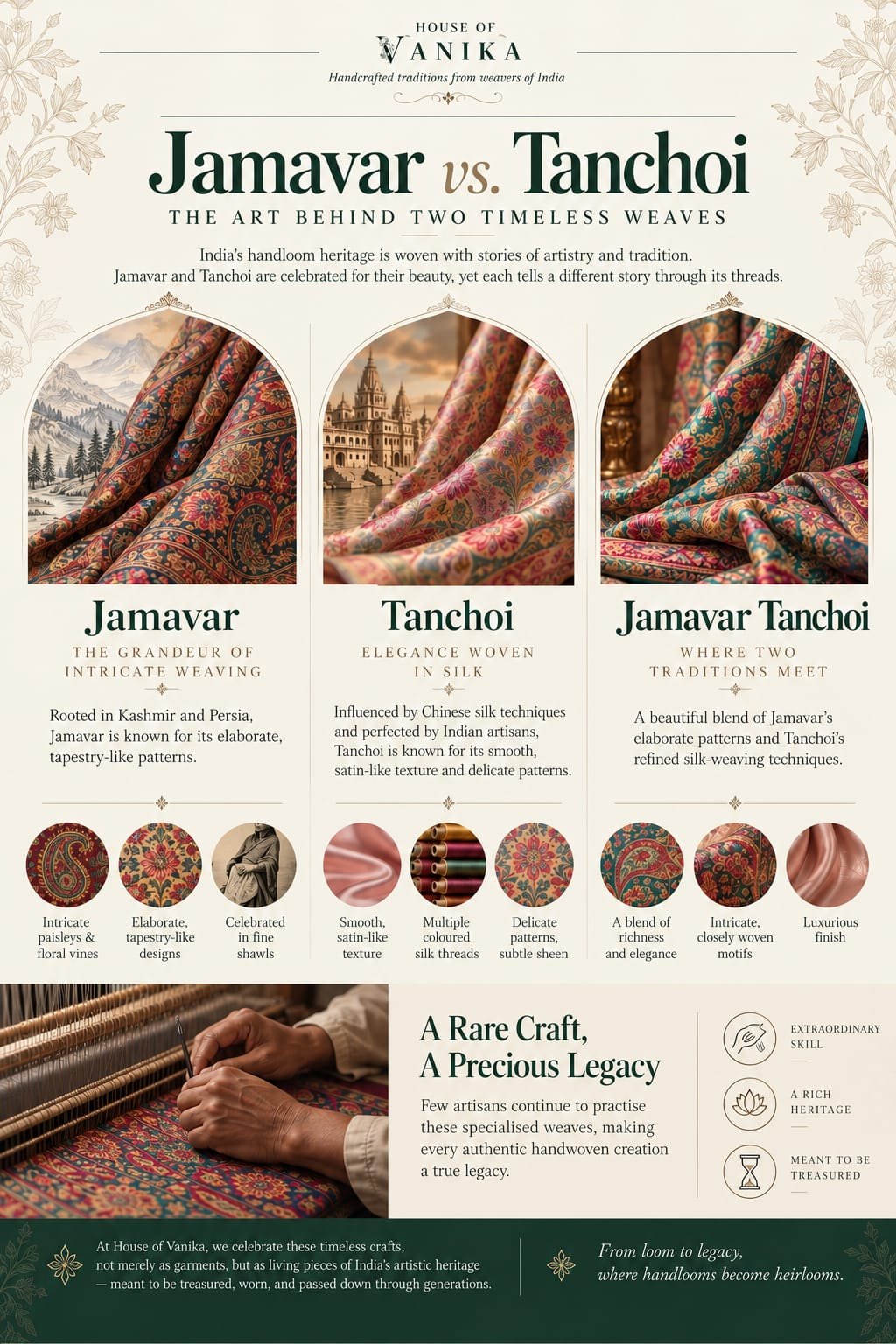
India's handloom heritage is woven with stories of artistry, patience, and tradition. Among its many treasured crafts, Jamavar and Tanchoi hold a special place for their intricate designs and luxurious appeal. While both are celebrated for their beauty, each tells a different story through its threads.
Jamavar: The Grandeur of Intricate Weaving
Rooted in the rich textile traditions of Kashmir and Persia, Jamavar is known for its elaborate, tapestry-like patterns. Intricately woven paisleys, floral vines, and traditional motifs often cover the fabric, giving it a majestic appearance.
Originally celebrated in fine shawls and later adapted into silk textiles, Jamavar reflects the grandeur of traditional craftsmanship.
Tanchoi: Elegance Woven in Silk
Tanchoi, a weaving tradition influenced by Chinese silk techniques and perfected by Indian artisans, is particularly associated with Banaras.
Known for its smooth, satin-like texture, Tanchoi uses multiple coloured silk threads to create delicate patterns, often without metallic zari. Its beauty lies in its graceful drape, subtle sheen, and intricate interplay of colours.
Jamavar Tanchoi: Where Two Traditions Meet
When the elaborate patterns of Jamavar meet the refined silk-weaving techniques of Tanchoi, the result is Jamavar Tanchoi — a beautiful blend of richness and elegance. Its intricate, closely woven motifs and luxurious finish make it a truly remarkable heirloom textile.
A Rare Craft, A Precious Legacy
What makes these weaves even more special is the extraordinary skill behind them. Today, relatively few artisans continue to practise certain highly specialised forms of Jamavar and Tanchoi weaving. With such traditional skills becoming increasingly difficult to sustain, every authentic handwoven creation carries a value far beyond its fabric.
At House of Vanika, we celebrate these timeless crafts, not merely as garments, but as living pieces of India's artistic heritage — meant to be treasured, worn, and passed down through generations.
From loom to legacy, where handlooms become heirlooms.